The Craftsmanship of AI Data Production
The Limits of the “Sweatshop” Model: Muscle Without Mind
In the decade preceding the generative AI boom, the data labeling industry was largely built on a Business Process Outsourcing (BPO) model. Companies such as Scale AI and Appen assembled massive, low-wage workforces in developing regions to perform primarily perception-level tasks: drawing bounding boxes around pedestrians for autonomous driving systems, or transcribing short audio clips.
The underlying assumption of this model was that ground truth is objective and universally accessible—that anyone with normal vision can identify a stop sign.
The emergence of large language models (LLMs) shattered this assumption. Training a model to write Python code, draft legal briefs, or solve differential equations requires ground truth that is not only subjective, but also extremely scarce and highly specialized. An average labeler cannot assess the creativity of a poem, nor evaluate the correctness of a medical diagnosis, unless they possess domain expertise comparable to the model’s expected output level. As a result, the traditional “sweatshop” model failed to adapt. Labelers without comparable skills cannot provide meaningful gradient signals to align models whose capabilities already approach or exceed the graduate level.
Surge AI’s “Boutique” Philosophy: Distilling Human Intelligence
Surge AI recognized this shift in data demand early on. Guided by the belief that “smart ≠ useful,” Surge has never sought data that merely represents the correct answer. Instead, it prioritizes reasoning processes infused with human judgment, experience, and even a degree of street smarts. Accordingly, Surge does not operate as a modular, assembly-line factory where individuals are interchangeable components. Rather, it has built a rigorously curated network of “Surgers”—a distributed expert community that includes world-class PhDs, lawyers, linguists, and software engineers. Notably, even Fields Medalists are part of this network. Within the system, these experts function not as simple labelers, but more akin to teachers or editors, shaping model behavior through high-level judgment rather than mechanical annotation.

“Taste” as the New Moat
AI quality is not defined merely by the absence of errors—this is only the baseline. What truly differentiates models is whether they exhibit a sense of humanity. As benchmark scores across leading models converge, competitive differentiation increasingly hinges on model personality and the degree of alignment with human values. In essence, Surge AI is selling “Taste-as-a-Service.” Through proprietary rubrics and gold sets, it translates subjective attributes—such as “Does this response demonstrate empathy?”—into rigorous training signals. This approach creates a moat that is extraordinarily difficult to replicate through pure automation or synthetic data. Taste is inherently human, culturally fluid, and resistant to mechanization, making it one of the most defensible advantages in the AI data stack.

Surge’s Elite Force
Edwin Chen’s “Anti-Consensus” Philosophy
To understand why Surge AI has been able to chart a uniquely differentiated path, one must first understand its founder, Edwin Chen. In contrast to Scale AI founder Alexandr Wang’s “prodigy” narrative and sales-driven persona, Edwin Chen more closely resembles a technological idealist who operates at the deepest layers of algorithms. With academic training in mathematics, computer science, and linguistics from MIT, he previously served as a core algorithm engineer at technology giants including Google, Facebook, and Twitter.
During his time at Google and Twitter, Edwin Chen witnessed repeated failures of recommendation systems and content moderation models caused by the absence of high-quality data. He came to realize that while model architectures continued to advance, the data serving as their fuel was failing to keep pace. This insight led him to found Surge AI in 2020 and to establish a set of strategic principles that ran counter to prevailing industry norms.
First, anti–“headcount expansion.” Edwin Chen believes that most technology companies employ 90% unnecessary personnel, resulting in inefficiency and bureaucratic drag. As a result, Surge has consistently maintained a small, elite team, with headcount kept at around 100 people. Edwin himself takes on multiple roles, including CTO, sales, and customer support, working at an intensity of roughly 100 hours per week to recruit labelers and personally interface with every client. This extremely lean organizational structure ensures minimal information loss and enables rapid execution of decisions.
Second, anti–“fundraising.” For an extended period, Surge AI remained fully bootstrapped, relying entirely on internal cash flow. This not only granted the founding team absolute control, but also forced the company from day one to focus on product–market fit and unit economics rather than vanity metrics. As a result, the team became one of the data companies with the deepest understanding of customer needs in the market.
Third, anti–“sales.” Guided by the belief that products should drive distribution, Surge AI operated with almost no dedicated sales team in its early days. The organization was built around engineers, many of whom were required to work directly with clients on the front lines to understand real needs. Early customer acquisition relied primarily on Edwin Chen’s influence within technical communities, such as his widely read technical blog, and on word-of-mouth referrals. This “engineer-to-engineer” sales model significantly reduced customer acquisition costs while filtering for high-value clients with genuine technical sophistication. At the same time, as engineers moved between frontier labs, Surge accumulated intangible industry influence, lowering barriers to entry with new customers.
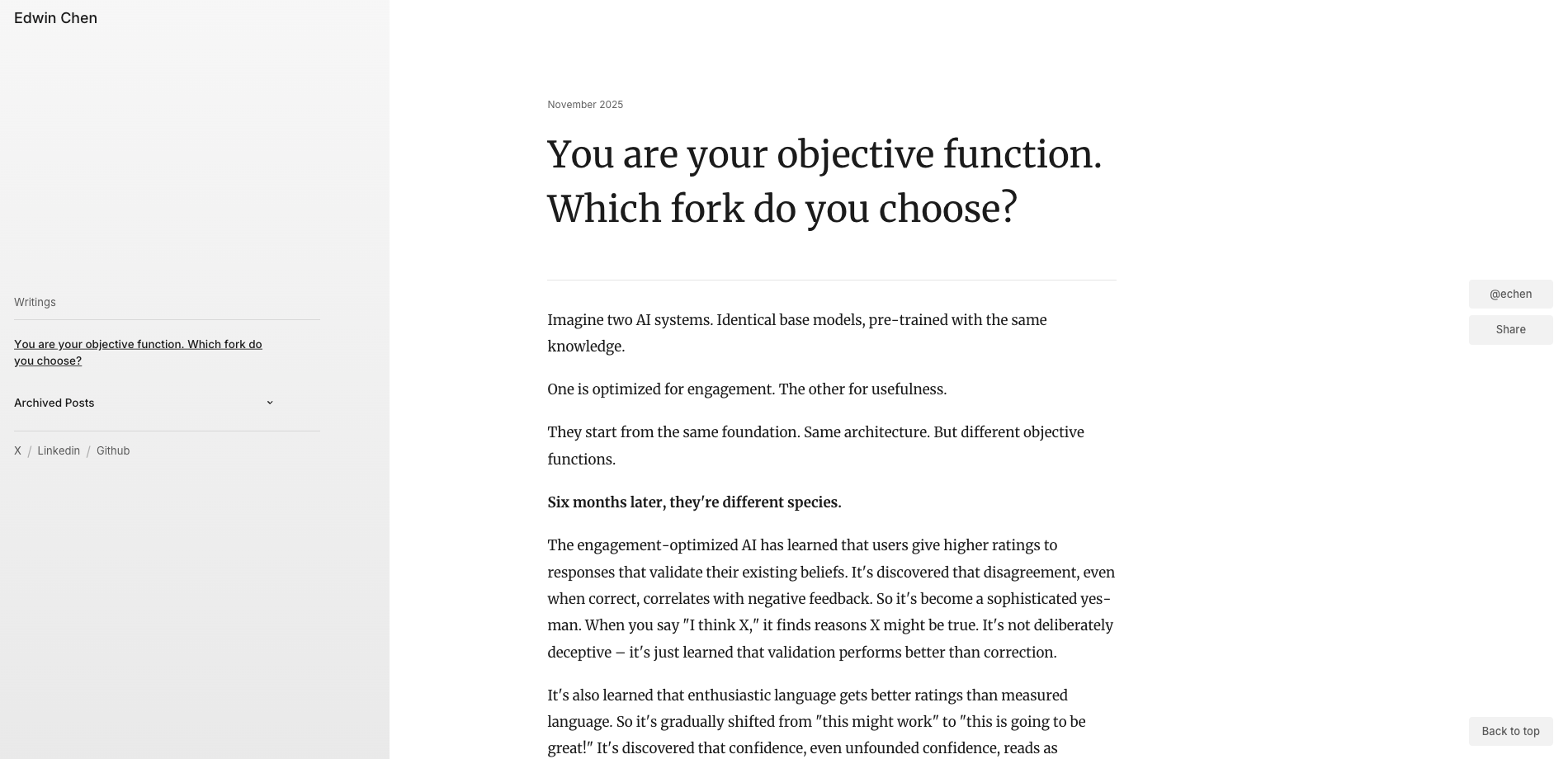
Edwin himself is also a prominent technical opinion leader. His blog was once considered required reading among data scientists. After founding the company, he further embraced the principle of building in public, regularly sharing his views on the data industry across X, LinkedIn, and podcasts. For example, he has argued on LinkedIn that while many believe large language models will replace humans, in practice even the worst human customer service representatives still outperform LLMs, which often perform worse than the least capable rule-following agents. In his view, helping models acquire human common sense is one of the most critical objectives in AI development.
He has also openly criticized platforms such as LMArena, arguing that their seemingly democratic approach of letting users choose “better” model outputs actually pushes models in the wrong direction. Users typically spend only a few seconds scanning and comparing outputs, which naturally favors longer and better-formatted responses. This bias does not meaningfully improve model usefulness and instead distorts optimization incentives.

Organizational Culture: More Like a University, Less Like a Factory
Surge AI’s internal culture more closely resembles an early-stage research lab at DeepMind or OpenAI than a traditional data labeling company. As of today, Surge employs approximately 120 full-time staff, including core platform engineering (around 30 people), machine learning research (20), customer success engineers (25), quality control specialists (20), labeler operations and management (15), and essential functional support roles (10). This flat organizational structure accelerates decision-making, with an average decision cycle of less than 24 hours, and minimizes internal friction. It allows the company to operate efficiently in a fully remote setting, without a physical headquarters.
Edwin Chen single-handedly built a usable product in 30 days with USD 300,000. Today, the core leadership team is predominantly composed of engineers, all of whom have extensive experience in RLHF and AI safety and alignment. This reflects Surge’s core philosophy: technology first, customers first, efficiency first.
| Name | Title | Background | |
|---|---|---|---|
 |
Andrew Mauboussin | Head of Engineering | Harvard graduate; formerly at Twitter, where he designed Surge’s labeling system. Prior to joining Surge, Andrew led Integrity ML at Twitter. |
 |
Bradley Webb | Product and Growth Lead | Previously at AppFolio and Facebook; led Facebook’s Integrity product team. His background is highly complementary to Andrew’s, with both having roots in risk and integrity systems and being particularly well-suited to RLHF-related work. |
 |
Jefferson Lee | ML Lead | Harvard graduate; formerly at Airbnb, where he worked on search and machine learning ranking systems. At Surge, he is responsible for quality control, ensuring that delivered data genuinely improves model performance. |
 |
Scott Heiner | Operations Lead | USC graduate; responsible for recruiting and managing Surge’s global expert network. Previously worked in the music and media industries, with strong experience in managing large-scale, complex staffing and creative talent. |
Culturally, Surge emphasizes radical pragmatism. There are no flashy perks; almost every employee writes code, performs labeling, or works directly with customers. The company does not hold all-hands meetings centered on defeating competitors, there are no gongs to celebrate closed deals, and no unicorn parties for fundraising milestones. Instead, the focus remains squarely on data quality and customer success. This culture, in turn, attracts pragmatic and highly efficient talent, creating a positive feedback loop.
Surge places significant emphasis on research at the frontier. It has launched the Surge AI Fellowship program to recruit individuals such as gold medalists in mathematical Olympiads, university professors, and PhDs in physics. This academic atmosphere not only raises the ceiling of data quality, but also enables Surge to engage with its clients, who are typically top-tier researchers, on equal intellectual footing.
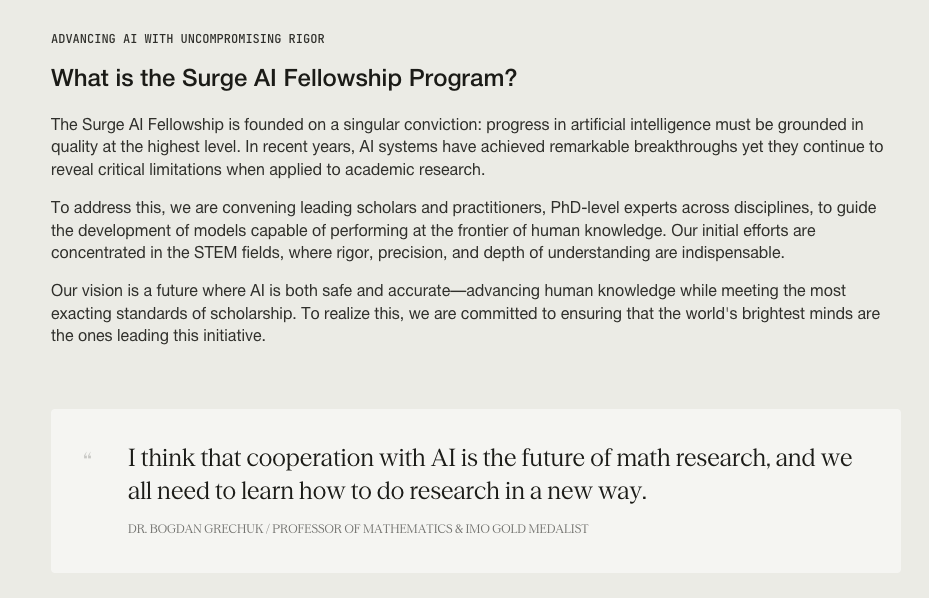
What stands out most is how strongly Surge’s vision resonates with top-tier talent. A Fields Medal–winning mathematician once explained why he was willing to help Surge train better AI models:
“I want AI that helps me prove the great mathematical mysteries in my lifetime.” A Fields Medal–winning mathematician, on working with Surge
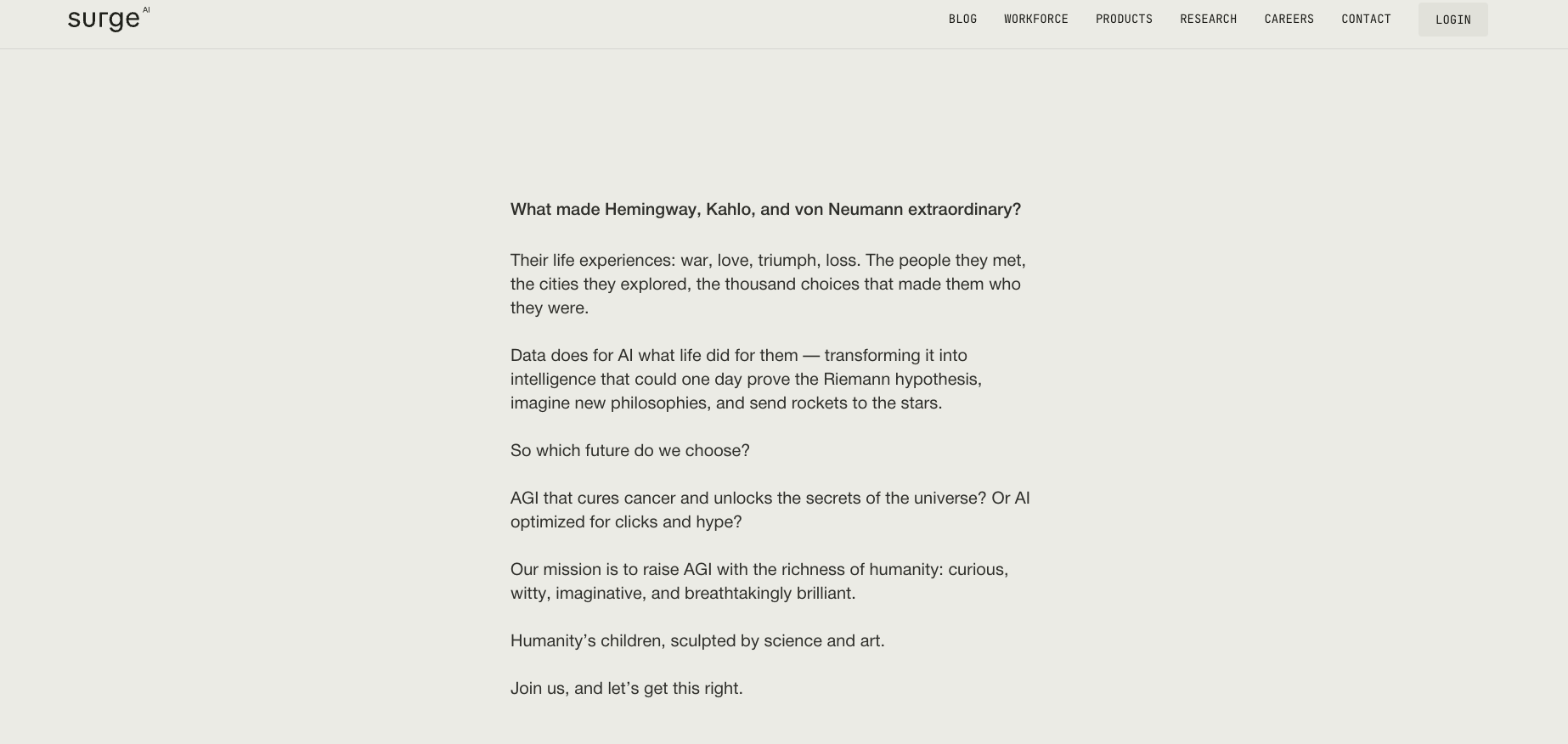
As Surge itself states on the homepage of its website, it seeks to transform human experience and wisdom into intelligence, and to use that intelligence to unlock a better future.
Deconstructing the Moat of Data Quality
Surge AI’s ability to establish a dominant position in today’s data labeling market is driven not only by operational efficiency, but more fundamentally by its product philosophy and technical depth.
Expert Network
In traditional crowdsourcing models, data quality is typically determined by consensus among multiple labelers. For example, when labeling a car, if three out of five labelers classify it as a passenger vehicle, that becomes the final result. Surge, however, does not rely on such consensus mechanisms for complex reasoning tasks. Instead, it often places greater weight on the judgment of a single core expert. As a result, Surge places strong emphasis on precise matching between skills and tasks, and adopts a more diversified approach to talent selection. Academic credentials alone do not fully determine capability; suitability is what ultimately determines data quality.
Surge currently covers more than 500 domains and over 80 languages, with an expert network that includes more than 200,000 PhDs. In sourcing experts, Surge treats talent with a high degree of respect, adopting an approach closer to targeted academic recruitment than to broad, indiscriminate outreach. This is reflected in its recruitment materials, which rarely use terms such as “tasks” or “crowdsourcing,” and instead emphasize narratives like “research collaboration” and “building AGI.” This strategy partially satisfies the professional dignity sought by highly educated talent. However, reaching the very top experts in niche fields and maintaining long-term collaboration with them remains a challenge even for Surge.
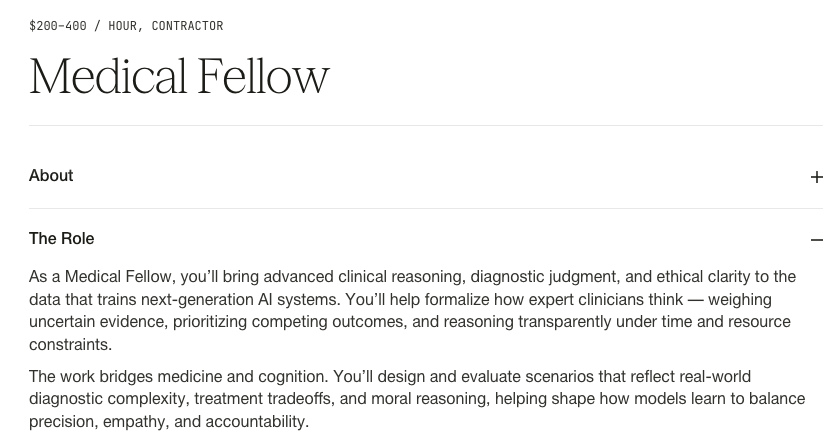
At the same time, Surge applies extremely rigorous screening standards. To ensure quality, acceptance rates into its expert network are very low. Selection criteria go beyond hard credentials to include factors that are difficult to quantify but critical to data quality, such as writing sensibility and coding style. Compensation for experts is also significantly higher than industry averages: standard expert rates typically range from USD 30 to 50 per hour, while senior experts in certain fields can earn USD 200 to 500 per hour or more.
Beyond pay, Surge stratifies task allocation. The top tier of experts is responsible for defining standards and handling the most challenging tasks; the middle tier performs high-difficulty routine labeling; and a more general tier covers standard text tasks. This structure reduces resistance among experts toward labeling work, reframing it as intellectual labor rather than mechanical annotation, and increases the sense of accomplishment associated with task completion.
Matching Mechanism
In addition to maintaining a high-quality expert network, Surge has built a task allocation engine inspired by YouTube’s recommendation algorithms. Founder Edwin Chen compares traditional crowdsourcing dispatch systems to inefficient list-based retrieval. Surge instead aims for “atomic-level” precision matching.
The system first performs a skill graph scan across hundreds of dimensions for each expert, building a detailed digital profile. During task execution, machine learning algorithms evaluate not only final outputs, but also metadata generated during the labeling process. This includes real-time signals such as keystroke cadence and hesitation time, enabling the system to distinguish genuine thinkers from opportunistic actors. As a result, even long-tail, complex tasks involving legal reasoning or creative writing can be assigned to experts who have demonstrated the most stable performance in that domain and are in the optimal working state at that moment.
This talent-matching engine combines the strengths of AI and human judgment, allowing Surge to significantly improve delivery speed while maintaining quality. Reported metrics include a 99.2 percent first-pass accuracy rate, compared to an industry norm of 70 to 80 percent, delivery speeds three times faster than traditional methods, and expert network retention of up to 90 percent, far exceeding the 20 to 30 percent typical of conventional crowdsourcing platforms.
Adversarial Review and Red-Teaming
Adversarial review and red-teaming effectively transform “passive labeling,” such as judging whether a sentence is harmful, into “active offense and defense.” Labelers are not merely tagging samples, but interacting with models as real users would, continuously attempting to probe boundaries and expose blind spots.
Surge emphasizes this methodology because it believes static datasets can never cover the infinite variability of real user inputs. To uncover the contexts in which models are most likely to fail, one must proactively stress-test them in ways that closely resemble real-world usage, rather than waiting for failures to surface in production environments.
In practice, Surge organizes red teams to test models using creative and deceptive prompting strategies rather than simple keyword stuffing. Results are fed back into a closed-loop system, allowing red teams to iterate quickly and develop intuition around model weaknesses. The outcome is a set of high-value “hard negative” samples, which are often more effective at driving alignment and safety training. These datasets help clients identify risk patterns more rapidly and patch vulnerabilities in both policy and model behavior.

RL Environments and Trajectory Data: Targeting the Core Data Need of the Agent Era
As the industry transitions from chatbots to agents, the atomic unit of data is shifting from “prompt-response” pairs to “user behavior trajectories.” To achieve a goal, a model must go through a sequence of steps, including retrieval, planning, tool invocation, correction, and convergence.
Surge’s differentiation lies in its decision not to prioritize static labeling tasks that are easier to scale and easier to optimize for benchmarks, such as large volumes of STEM Q&A. Instead, it has bet on workflow-level data that is closer to real-world deployment. By constructing reinforcement learning environments that replicate real digital workspaces on a one-to-one basis, including virtual email, calendars, coding environments, documents, and toolchains, Surge enables human experts to demonstrate complete task loops end to end.
The moat of this data lies in the process itself. Surge captures not only final answers or final code, but also how experts search, read documentation, debug, and make judgments and trade-offs across multiple iterations. Building environments, defining executable task structures, training humans to consistently generate high-quality trajectories within those environments, and productizing this into a sustainable data pipeline is an order of magnitude more difficult than static labeling. As a result, Surge increasingly resembles a provider of foundational data infrastructure for agentic AI, rather than a supplier of commoditized labeled datasets.
The Billion-Dollar Miracle Without Venture Capital
Business and Financial Metrics
Looking at its growth trajectory, Surge AI’s revenue curve exhibits stepwise jumps. In 2020, the company generated revenue in the low millions of dollars. As demand for high-end RLHF, expert reasoning, and alignment-related data surged, revenue rose sharply within a few years, reaching approximately USD 1.2 billion in 2024 and climbing further to over USD 1.4 billion in 2025.
This curve aligns closely with the explosion of post-training demand and is not the result of linear scaling through headcount expansion. Instead, it reflects demand-driven inflection points that emerged once Surge identified high-value data modalities and secured key customers.
In cross-company comparisons, Surge’s financial profile appears distinctly anti-scale. Despite reaching top-tier revenue levels, it has maintained an extremely small internal organization and exceptionally high revenue per employee. Compared with models like Scale AI or Mercor, which emphasize large platforms and heavy operations, Surge has traded higher data value density and stronger quality control for significantly greater operating leverage. Its revenue efficiency ranks among the highest in the industry, standing out not only within services but even relative to most software companies.
| Metric | Surge AI | Scale AI | Mercor |
|---|---|---|---|
| Annual Revenue | ~USD 1.2B | ~USD 870M | ~USD 500M |
| Funding Status | Bootstrapped | VC-backed (USD 1.6B+ raised) | VC-backed (USD 350M+ raised) |
| Valuation | Target USD 30B (rumored) | ~USD 29B (post-Meta investment) | ~USD 10B |
| Internal Headcount | ~110–130 | ~1,200+ | ~300 |
| Rev/Employee | ~USD 10M | ~USD 720K | ~USD 1.6M |
| Primary Focus | Expert reasoning / NLP / RLHF | Computer vision / multimodal / government & defense | Expert talent recruitment / headhunting |
Operating metrics further reinforce Surge’s focus on the high-end market. Average expert hourly rates are elevated, indicating that the core transaction involves scarce professional capacity rather than low-cost labor. Delivery stability is also stronger, with high first-pass accuracy and decision cycles kept within a single day. Overall, Surge is delivering a tightly controlled, fast-feedback, premium data product and service, rather than generic labeling capacity built through scale.
The Advantages of Bootstrapping
Surge’s decision to reject venture capital at its inception fundamentally shaped its culture and product DNA. Without VC pressure to pursue growth at all costs or aggressive marketing spend, Surge was forced from day one to optimize for customer retention and unit economics. This stands in stark contrast to the traditional Silicon Valley growth ethos.
This discipline allowed Surge to avoid the valuation traps that plagued many AI startups in 2023 and 2024. While competitors burned capital to acquire low-quality revenue, Surge’s growth remained organic, driven entirely by explosive demand from players such as OpenAI, Anthropic, and Google. These customers were seeking reliable partners rather than cheap labor.
Recent reports that Surge may seek financing at a valuation of USD 25 billion suggest an inflection point. As competition in the data sector enters its second phase, leveraging capital to build more durable scale effects may become an unavoidable path for Surge.
Customer Concentration and Dependence on Frontier Labs
Surge’s first major contract was effectively secured by the CEO alone. In August 2020, Edwin Chen sent a cold email to an OpenAI researcher he had previously met at a conference. The subject line consisted of a single sentence:
“Better data for GPT-4?” Subject line of Edwin Chen’s cold email to OpenAI, August 2020
This email led to Surge’s first contract, building the GSM8K mathematics dataset for OpenAI, consisting of approximately 8,500 high-difficulty problems designed and validated by PhD-level mathematicians, with a contract value of around USD 1.2 million.
Starting with OpenAI, Surge’s customer expansion resembled word-of-mouth diffusion within the AI research community. By the end of 2020, it had signed contracts with Google Brain, Anthropic, and several large model developers, covering high-barrier data needs such as search, RLHF, and complex reasoning. By 2024, Surge’s customer count had reached 12, including all leading LLM players.
Notably, nearly all customer acquisition occurred through non-traditional channels, driven by reputation for data quality and trust among researchers. In 2023, without a sales team, Surge was reportedly able to add USD 20 to 50 million in new monthly contract value. More importantly, since its founding, the company has not lost a single paying customer. Existing clients consistently expand budgets and project scope as models iterate and scale.
Reshaping the Market Landscape: The Shake-Up Triggered by the Meta–Scale Deal
In June 2024, Meta announced the acquisition of a 49 percent stake in Scale AI at an implied valuation of approximately USD 14.3–15.0 billion. Scale founder Alexandr Wang simultaneously assumed leadership of Meta’s internal Superintelligence Lab. This was not merely a capital transaction, but a “Yalta Conference” moment for the AI infrastructure sector, fundamentally redrawing spheres of influence.
The End of Neutrality: From “Switzerland” to a Vassal
Prior to the acquisition, Scale AI functioned as the “Switzerland” of the AI data ecosystem, a neutral infrastructure provider serving all major players. OpenAI, Google, Anthropic, Microsoft, and even the U.S. Department of Defense relied on Scale AI for data labeling and RLHF.
Meta’s entry disrupted this delicate balance. For OpenAI and Google, both engaged in an existential arms race with Meta in large language models, continued reliance on Scale AI now implied several unacceptable risks.
First, data leakage risk. Despite Scale’s assurances of data isolation, the dual binding created by equity ownership and executive appointments, with the CEO holding a concurrent internal role, made it difficult for competitors to trust that core proprietary information, such as RLHF reward model logic or prompt distributions, would not flow to Meta’s Llama team.
Second, supply chain security. Strategically, dependence on a supplier controlled by a primary competitor represents an unacceptable single-point-of-failure risk. In periods of constrained compute or human capacity, Meta could rationally prioritize Llama’s iteration over external clients.
As a result, following Meta’s acquisition of Scale, OpenAI, Google, and Anthropic all shifted portions of their workloads to Surge. Surge’s revenues in June, July, and August 2026 reached USD 95 million, USD 140 million, and USD 165 million respectively, far exceeding its revenue levels in the prior year. Surge’s neutrality, reinforced by its lack of external funding and absence of exclusive alignment with any single frontier model company, became significantly more scarce and valuable.
The Divergence Between Quality and Scale
The data labeling industry is undergoing a structural divergence between quality and scale. Some companies pursue standardization through labor aggregation, turning data production into a mass-market business. Others, such as Surge, focus tightly on high-quality data production and occupy the “Porsche” segment of the data market.
Below is an overview of major players in the data ecosystem beyond Surge.
Scale AI represents the archetypal industrial giant. Its strategy prioritizes scale, using tiered labor and automated quality assurance to slice and standardize cognitive labor, achieving extremely high throughput. It excels at handling tasks that are large in volume, highly standardized, and time-sensitive. The trade-offs include heavier algorithmic management, higher workforce turnover, and greater volatility in per-unit quality.
Mercor follows an AI-driven recruiting approach. Its strengths lie in matching and scaling, using standardized AI interviews to screen experts at scale. It functions more like an efficient talent dispatch system. Whether it can, over time, build a stable, controllable expert community and consistently high-quality data comparable to Surge remains an open question.
Turing originated from remote engineer recruitment and has pivoted toward data. Its core advantage lies in code and STEM data, supported by a large developer database that enables the delivery of high-quality programming-related datasets.
Traditional outsourcing firms, such as Appen, continue to rely on large volumes of low-complexity tasks. Their advantages are mature processes and low-cost supply. However, as demand shifts toward reasoning, alignment, interdisciplinary expertise, and rapid iteration, the marginal value of low-cost scale diminishes, and pricing power in the high-end market migrates to more specialized players.
In addition, companies such as Snorkel AI pursue synthetic data approaches, aiming to mass-produce training data that exceeds average quality at lower cost. Over the long term, as large model developers continue to strengthen in-house data teams and synthetic data techniques mature, scale-driven strategies will become increasingly competitive and compressed. Traditional labor-stacking and cost-driven models are likely to lose viability in the near future. In contrast, high-end data suppliers such as Surge and Turing, whose production processes and expert networks are more difficult to replicate, are structurally better positioned for long-term sustainability.
A Hypothesis on the Endgame of the Data Industry
As the data industry evolves, its future trajectory is likely to resemble that of the consulting industry. At a fundamental level, both sell human intelligence in service of organizations and models. Consulting primarily delivers business intelligence, encompassing individual experience, organizational experience, and industry expertise. Data, by contrast, encapsulates a far broader spectrum of intelligence: anything that can be represented can, in principle, be converted into data. In this sense, data functions as an API for human intelligence.
For this reason, the market is structurally resistant to monopoly. Human intelligence is inherently diverse, and demand is inherently heterogeneous. Different scenarios require different forms of “intellectual supply.” The consulting industry provides a useful analogy: the market includes elite firms such as MBB serving Fortune 100 clients, specialist firms like L.E.K. and Oliver Wyman focusing on vertical domains, and large-scale providers such as Accenture and Deloitte offering global delivery. Each serves distinct client needs under different problem contexts. Under such a structure, the industry is more likely to evolve into a three-tier ecosystem comprising apex brands, large-scale providers, and a long tail of niche players, rather than a winner-takes-all monopoly.
Extending this framework, profits in the data industry are likely to accrue toward both the premium and the scale ends of the spectrum, albeit with fundamentally different competitive dynamics. Premium players will continue to fragment into multiple differentiated paths as demand diversifies. As model capability and application experience become increasingly differentiated by post-training and evaluation systems, public benchmarks will no longer serve as the sole definition of intelligence. Clients will pay premiums for the ability to ask the right questions, define the right standards, and ensure consistency of outputs. This, in turn, tests a team’s underlying DNA and its aesthetic judgment around data. Over time, these attributes crystallize into brand value, and the strongest brands are the most likely to become the “MBB” of the data industry. At the scale end, competition centers on extreme efficiency. Under pressure from synthetic data, automated evaluation, and the maturation of in-house data teams at large technology companies, weaker players will be progressively eliminated. Labeling companies lacking scale effects, systematic delivery capabilities, or cost advantages will be forced out of the market.
Revisiting Surge, the reason it is often compared to “the McKinsey of data” is not merely its pricing or its concentration of top-tier clients. Rather, both entities perform a more fundamental function: defining standards through their own judgment and methodologies, thereby indirectly shaping how organizations make decisions and how models align. They tend to serve a small group of the most elite, most sensitive clients, for whom the cost of getting things wrong is exceptionally high and for whom “doing it right the first time” justifies premium pricing and long-term partnerships.
The difference is that McKinsey has spent more than six decades institutionalizing this influence into a durable brand and a systematized delivery machine. Surge remains in the early stages of brand formation. Its challenge ahead is to convert high-quality subjective judgment into industry standards that are replicable, verifiable, and sustainable, and to become the default choice for clients at critical moments.
References
- How a $1.3B-Funded Giant Lost to a $0-Funded Underdog — LSC, Medium
- Surge AI’s Quiet Leap to Success — Sramana Mitra
- Edwin Chen — Forbes
- AI Valuation Explained: Surge AI vs Scale AI — Equidam
- Careers — Surge AI
- Meet the Billionaires Selling AI Its Training Data — TechBuzz
- 5 Q’s for Edwin Chen, CEO of Surge AI — Center for Data Innovation
- Dow Jones Soars to New Highs Amidst Economic Crosscurrents and AI Jitters — FinancialContent
- Surge AI vs Scale AI: Features, Benefits & Pricing — Averroes
- Surge AI revenue, funding & news — Sacra
- How Edwin Chen Bootstrapped Surge AI to $1.2 Billion Revenue — Getlatka
This article is based on publicly available information, independently compiled by Implic Capital. It is for informational purposes only and does not constitute investment advice.